
How to teach piano with solfa
Teaching piano with solfa means students learn music as sound first: they sing it, sign it and feel it, and the keys and the stave grow out of what they already hear. This guide walks through how I do it, from a child's very first lesson to reading on the stave.
It's for teachers who want their students to hear the music they play, whether you use the PianoForte Method or simply want to add solfa to the books you already use. You don't need to be a confident singer, and you don't need Kodály training to start.
What solfa is, and why teach piano with it
Solfa gives every note of the scale a sung name: Do, Re, Mi, Fa, So, La, Ti. With moveable Do solfa, Do is always the home note of the key, so So to Mi sounds the same in any key. Students learn how notes relate to each other, not just where they sit on the keyboard.
The approach goes back to the British teachers Sarah Glover and John Curwen, who taught groups of children to sing in schools and churches, and to Zoltán Kodály, who built on their work to reform music teaching in Hungarian schools. Their students developed fine musicianship long before they read notation.
At the piano, solfa matters because it's easy to play without listening. Notes on a page can be matched to keys on the piano. But notated music is not a code telling you what black or white note to press. Notation is a representation of musical sound. When students hear the music first, reading becomes a way of understanding something they already know, not a code to crack. Good aural skills make playing by ear possible, but they also make everything else possible, including:
- sight reading quickly in any key
- understanding chord progressions and the big structural themes of a piece
- shaping phrases with nuances that can't be described in words
- hearing the difference between pp and ppp, and making a colour change
Aural training is NOT the same as “playing by ear”.
Read more: Playing by ear is not the same as developing the ear and Aural skills or music reading?
Sing first
Before a student touches the keys, we make music together: we sing, move and listen. Sharing and experiencing music with children is what prepares them to read it later.
In the first lessons I start with the voice itself. We move our voices up and down together, make it silly with animal sounds that go high and then low, and stretch up high and bend down low. Then we take that to the piano to explore high and low sounding keys.
The first two solfa notes are So and Mi. These sounds are easy for children to pitch, and they give a perfect chance to build healthy technique from the start. We sing songs such as Flying Birds and Little Mouse until the student knows them well, with drums or shakers to feel the beat. The music should be in their ears and voice first, and on the page second.
If you're not a confident singer: it's not actually about singing. Singing is the tool that helps students develop strong aural skills and hear the piano as it really is, like a choir of voices, lines and harmonies. You don't need a beautiful voice, just a willing one.
“You must sing if you wish to play.” Chopin
Read more: It's not just about singing, Aural training in the first piano lessons and The first piano lesson
Hand signs
The Curwen hand signs give each solfa note a shape, held at a height that matches its pitch. Do is a closed fist low down, So is a flat hand held higher, and Mi is a flat hand turned down in between. Students see the distance between notes and feel it in their bodies.
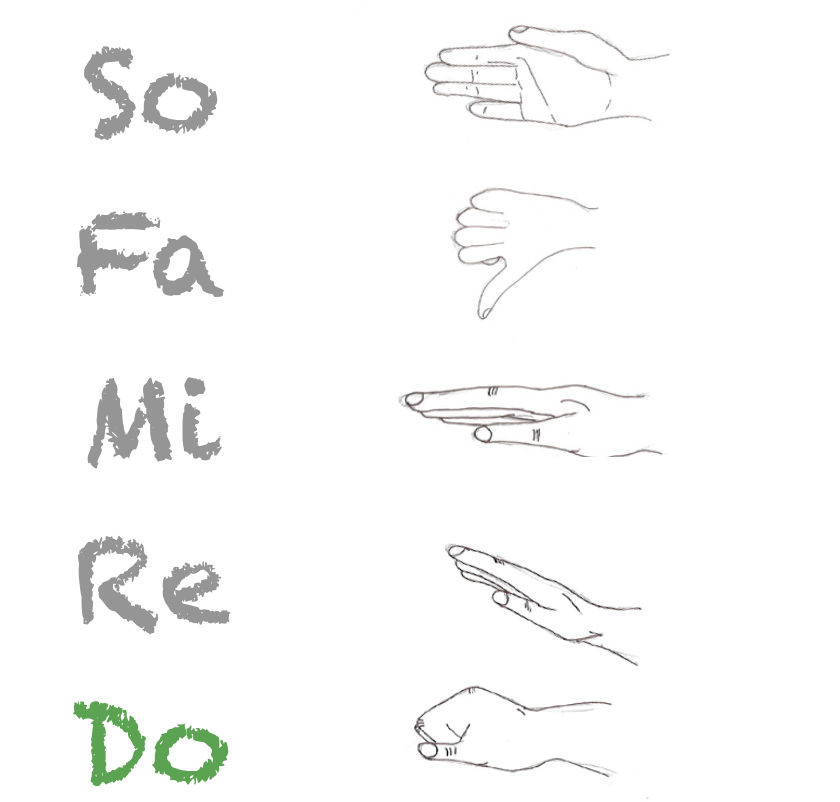
Use them in every lesson:
- Sing and sign together. Sign as you sing a new song so students link the sound to the shape.
- Sign, they sing. Show a pattern of signs silently and let students sing it back. It's a quick check that they really hear it.
- Sing, they sign. Sing a short pattern and ask students to show the signs. It's ear training without a worksheet.
- Sign, then play. Sign a pattern and ask students to find it on the keys in their current position.
Watch it in a real lesson: Curwen hand signs for So and Mi
From the voice to the keys
Once a song is secure in the voice, it moves to the piano. Students already know how it goes, so their attention can go to the keyboard and their hands.
In Level One, a student's first lesson covers:
- Hands and finger numbers
- The layout of the keyboard: black and white keys
- The singing voice, and high and low sounds
- The solfa notes So and Mi
- The first song, Flying Birds
- Playing in different positions
That last step is the important one. Each piano piece has three positions to try, so students are transposing from the very beginning. They play it high and they play it low. Children love discovering they can play it “anywhere”, and because they're thinking in solfa, not letter names, they understand why it works. It's the first step towards really understanding how music works.
As new notes are added (Do, then Re, La and the rest), each one is sung and signed first, then found on the keys. Level One stays in solfa throughout, so there's no rush to read: time spent on these early concepts is never wasted.
See every Level One lesson taught: Level One video walkthrough
From solfa to the stave
When we teach musical sound first, notation easily follows. To introduce any symbol, I introduce the sound first, let students experiment making the sound, and then say “this is the symbol we use to represent that sound”.
In PianoForte Level Two, students make the move from singing to reading. It starts with Treble G, the G that's easy to sing because it's not too high and not too low. The treble clef looks a little like an old-fashioned letter G, and the line through its centre is that Treble G. Other notes sit above and below it on the lines and spaces. Some children need a little time to see the lines and spaces going up and down, and that's easily helped with simple games and practice.
From then on, each piece in Level Two appears twice, once in solfa and once on the stave:
- Sing the solfa and the rhythm, away from the piano.
- Play the solfa version on the piano, in all its positions.
- Turn the page and play the notated version.
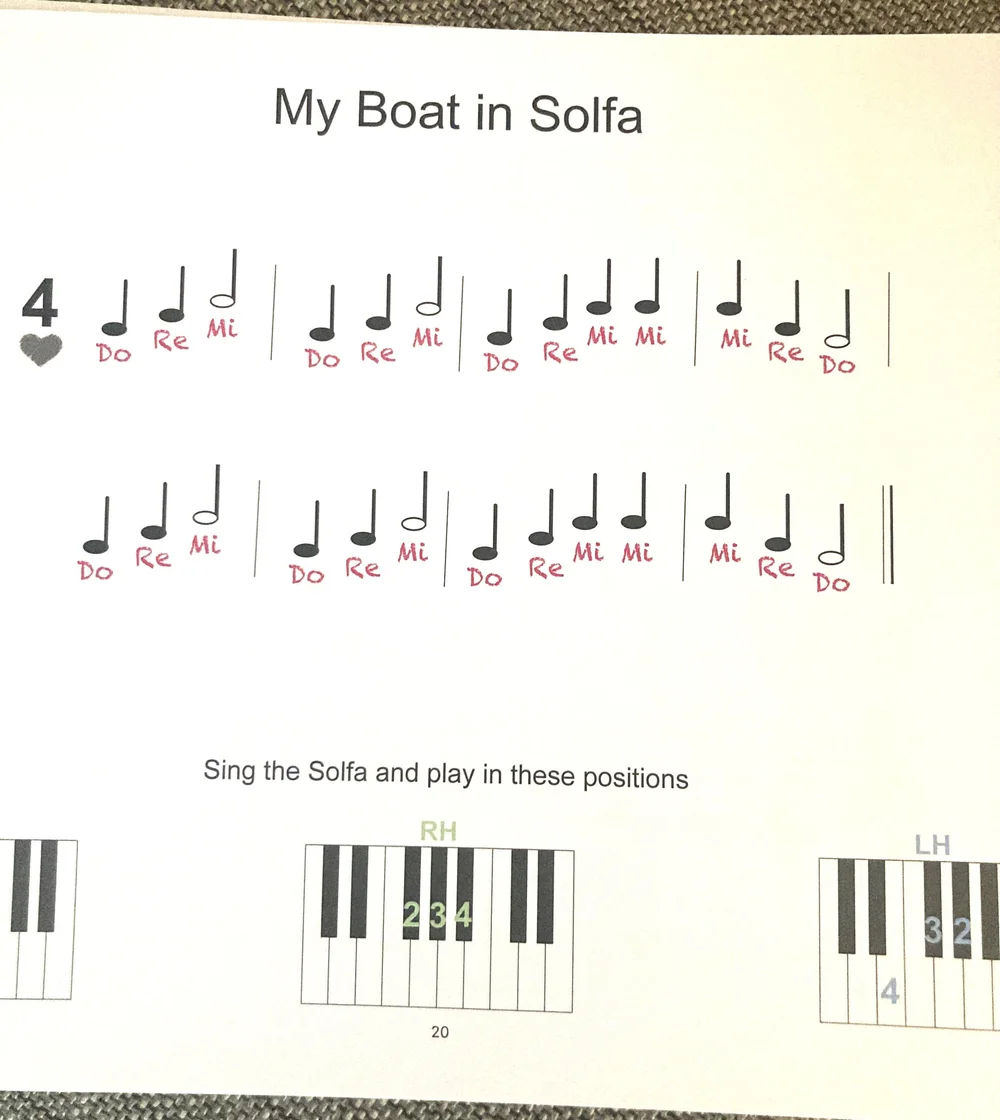
At step three, a short conversation is usually all it takes:
“When we sing Mi to So, what are we skipping?” “Fa.” “So how do we skip Fa on the stave?”
Students skip over a line or a space, and they understand why, because they already know Mi to So skips Fa. Children learn to read in tonal centres, hearing the distances between notes instead of counting intervals. That paves the way for the great piano repertoire, and for harmony, theory and scales.
Read more: How to make the transition from singing solfa to reading music
Questions teachers ask
I'm not a good singer. Can I still teach this way?Yes. It's not actually about singing: singing is simply the tool for building the ear. Sing at a comfortable pitch, keep it light, and let the students hear you enjoying it.
Won't my students struggle to read music?No. Kodály's own work was for classroom singing, which is why some people link it with weak reading. At the piano we make the move to the stave deliberately, and students who already hear the music usually read faster and more musically.
Isn't this just playing by ear?No. Aural training is not the same as playing by ear. It makes playing by ear possible, but it also makes sight reading, harmony and expressive playing possible.
Do I have to change everything I do?No. You can keep the books you use and add the solfa activities from Level One alongside them: sing the song first, sign it, then play it.
Fixed Do or moveable Do?Moveable Do. Do is always the home note of the key, so students hear the same relationships in every key, and transposing comes naturally.